Wednesday, April 16, 2014

Seoul to Japan to Seoul - Tokyo

The last two days of Japan were reserved for the enormous city of Tokyo. Just picking a neighborhood to stay was daunting. Do you pick a traditional neighborhood, a party neighborhood, a centrally located neighborhood, a touristy neighborhood? Tokyo has them all and even multiples. And since Tokyo is so huge, the neighborhoods are fairly spread out so it's a fairly big deal if you don't want to hotel hop every night.

The neighborhood I chose was Shinjuku. It's a party neighborhood that is located in the northwestern part of Tokyo and also is very close to the world's busiest subway station in Shinjuju.


Much time was spent wandering around through markets, getting lost on the winding streets and window shopping at interesting stores. But one of the things I really enjoyed was visiting one of the popular cat cafes. You pay a fee for the time you spend and can also buy coffee or tea and desserts as well as cat treats to lure the cats to you since it is only allowed to pet the cats, not pick them up or hang on to them. There were two floors in the cat cafe that we visited. After getting a badge, you removed your shoes and washed your hands before walking into the cat room. There are lots of different kinds of cats and lots of toys to play with them as well as couches to relax and drink your coffee while you watch the kitties.

Photo   Photo

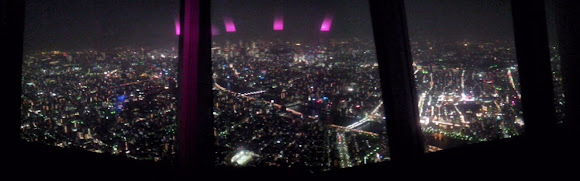
There are two towers in Tokyo, the Tokyo Tower and the Tokyo Sky Tree. The Sky Tree is listed as the world's tallest tower. It's used as a broadcasting tower but with obvious tourist attractions on a few of the higher floors as well as a plethora of shopping opportunities surrounding the base. I visited the tower at night and it was indeed breathtaking. The sparkling city lights of Tokyo stretched as far as I could see in every single direction I looked. It was jaw dropping gorgeous, really. Photography is quite difficult due to the bar placement around the windows and the interior light reflections at night though.


PhotoPhoto

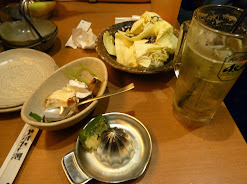
I sampled sushi, soup, dumplings, fish dishes, bakery delicacies, and amazing handmade ramen. The food was superb and I miss it intensely.

Photo  Photo  Photo      Photo

Japan was a truly amazing country and someday it would be fantastic to return and see more of the islands and countryside and also see it during cherry blossom season. But until then, the memories I made are wonderful and lasting. I hope you enjoyed my tales and pictures. This was the send off I received at the airport...fitting don't you think?  :)


~~~~~~~~~~~~~~~~~~~~~~~~~~~~~~~~~~~~~~~~~~~~~~~~~~~~~~

I've already begun another travel adventure; not for work mostly, but for play. Watch for a new entry soon detailing the beginning of my most recent trips!

Monday, April 14, 2014

Seoul to Japan to Seoul - Kobe, Osaka, Kyoto


The next two days of my journey were spent in the three cities of Kobe, Osaka and Kyoto. They are all very near each other so it was easy and quick to get from one to the other.

I arrived in Kobe late morning after a train ride from Hiroshima. For lunch my friend had his heart set on sampling the world famous Kobe beef so we headed to a nearby restaurant.

Since it was lunch time the price was more reasonable and it included a salad, soup, veggies, ice cream, coffee, and the steak of course. Breaking my vegetarian diet to sample this potentially once in my lifetime opportunity meal, I was wowed! Ethically speaking there are a couple sides to the Kobe beef issue, although none of the urban legends are confirmed. I personally didn't go out into the hillside and see the cow treatment for myself, but knowing there are only around 3000 head of this beef, that doesn't leave near as much measure for the overcrowded facility treatment that is so commonplace in America.

So leaving behind the ethics debate, I'll move on to the taste agreement. For sure, Kobe beef is the best tasting meat I've ever eaten. It nearly obliterates from memory all other steaks previously enjoyed. The belief that steak needs sauce or dips or rubs or added flavor is inaccurate in regards to Kobe beef. There was nothing but sea salt sprinkled on as the chef began grilling the steak on a hibachi grill right in front of my eyes. Then, after getting a few bites ready, he offered me the first bite instructing that I not place it in more salt or pepper or sauce, but just eat it completely natural. My taste buds exploded and an involuntary "oh wow" escaped from my lips. I expected it to be good but my expectations were shattered with the flavor and melting meat in my mouth.

Photo  Photo   Photo


Unfortunately, you can't get Kobe beef in America. You'll have to go to Japan. All the people claiming it elsewhere are making false claims. Ask them for the 10 digit code that proves what cow it came from if you want to verify it's authenticity and you'll find they don't have one for you. Some restaurants import the same cattle but from other prefectures. It's not actually Kobe beef but it's really close. You'll pay a pretty penny though, so beware. If you want to experience the true thing, just go to Japan. The country is worth the visit and the Kobe beef is one of the extreme highlights along the journey.

After lunch it was time to explore the nearby woodlands. I hiked up through several small waterfalls, around a dam, up some giant sized steep stairs, and then strolled along a rather steep incline that wove its way through the Herb Gardens. Since it was winter time, not much was blooming but things were planted and the ground was being taken care of quite meticulously. It was still very beautiful. At the top there was a very handy and welcoming cable car ride to the bottom where it was time to jump the train to Osaka for dinner.

Photo Photo

Photo  Photo

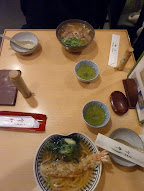
Osaka has an entertainment district called Dotombori. It's a canal street that's super lit up with so many lights it's distracting. It's also crowded so moving along can be slightly difficult, even if it's a weekday evening. There was a recommended old fashioned noodle house in the Lonely Planet guide book so off I went for some udon. (Udon is a type of thick wheat flour noodle of Japanese cuisine. Udon is often served hot as a noodle soup in its simplest form, as kake udon, in a mildly flavored broth called kakejiru, which is made of dashi, soy sauce and mirin ~ thanks Wikipedia) This was by far the best udon I've ever had before and since. The noodles were perfect and the broth was delectable! I had a tempura prawn in mine and with the flavors of the broth soaked into it, that prawn was the most delicious prawn I've ever had in my life! I could have had two bowls of that soup!
Photo 

But the night was young, so after a light dinner it was off to explore and hunt down some sake!  The first bar was a hole in the wall, straight out of a movie scene, packed with locals, nice looking bar...that didn't serve any sake. So instead (I wasn't going to waste the trip, right?) I enjoyed some nice port wine as an after dinner beverage.

Photo Photo

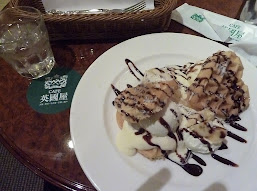
Now the need for dessert got much stronger and it was time to taste the famous waffles advertised and eaten for every meal in every restaurant it seems. It wasn't hard to find an open cafe with some waffles served with ice cream, chocolate sauce and a banana, YUM!
Photo

After dessert it was back to the mission of sake hunting. It is now extremely apparent that the Japanese don't drink sake like the Koreans drink soju. Both are the local famous beverage, but the Japanese merely export it because many bars don't even offer it and you rarely see the locals drinking it (this was my experience anyway).

After much hunting, I finally found a bar that had sake plus a lot of character! I mean, a lot of character. And the owner surely put his character into the bar because he was sooo thrilled to see Americans. My friend and I were ushered upstairs along some crazy narrow stairs (the kind where you have to use the right foot on the corresponding stair to walk up them) into a small room with silver Sharpie writing everywhere. There was a little sink and a little bathroom and just a few very small tables. He brought us some free food and a nice sake gift set. Then as we went to leave the bar he offered to take our picture and thanked us a million times for visiting.

Photo    Photo

It was late by then and time to head to bed before a big day in Kyoto the next day. Osaka sure was fun and full of life. Someday I'd love to go back!

My favorite artsy picture of the Dotombori Canal featuring the ever popular bicycles and sparkling lights!

Kyoto is known as one of the most beautiful cities in Japan and in the late spring/summer and maybe even fall I could see the possibility, but during the winter... it just wasn't charming for me.

Still, there were many many many many (did I mention there were many?) temples and castles and other various religious monuments to go see. My friend wanted to go see the Golden Palace first so we did. Here's the picture.

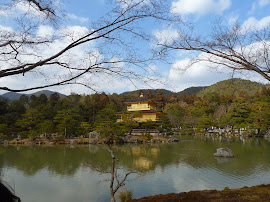
Photo  Photo

Yes, it's gold. Would I bother going all the way there to see it? No, the Notre Dame dome in South Bend is just as big and more sparkly if gold is your thing, and there are many other more fascinating historical monuments elsewhere around the world.

Kyoto was where the hot pot meal was had. It was all you could eat for 2 hours and it was very delicious! Definitely still a huge fan of hot pot!

Photo\

Geisha's are a popular sight in Kyoto and in the Gion district you can see them walking home every evening.


Photo


Photo
These girls were even nice enough to take a picture with us.
All in all, it was a fun and fast couple of days. In Kyoto was were I stayed in a Ryokan, the traditional Japanese housing. There are tatami mats on the floor with some cushions and blankets and that's about it. It was actually super soft and comfy. Ryokan stay, check :) Next it's off to Tokyo!

Wednesday, April 9, 2014

Seoul to Japan to Seoul - Hiroshima

After a short flight from Seoul to Fukuoka, and my favorite noodle dish of the entire visit to Japan!, it was time for my first bullet train ride ever!

Photo

I was really excited to experience these famous trains. Getting the ticket wasn't too difficult, but traversing the station for the first time was impossible. I'm well versed in traveling foreign transit and can almost always find my way around fairly quickly and rarely have to ask for directions. I actually had to ask a passerby for help trying to read the track schedule. Once that was figured out I made another error not realizing that the trains are different lengths so for some trains you use one set of boarding numbers and for other lengths you use different sets of numbers. I know now :)  I didn't miss the train though so that is good!

The train was quite nice and comfortable and quite. But as soon as we started there was an instant pressure on my ears. My ears don't ever pop. Even if I fall asleep on the ground and awake in the air during flight, I'll be nearly deaf and in some pain because my ears haven't popped at all. This train pressure was different though. It didn't build up, but was instant and wouldn't go away if I swallowed or chewed gum or yawned really big. After a few minutes it hurt and I was miserable for the remainder of that ride and into the rest of the day as my ears recovered from the journey. I was carrying three-tiered decibel lowering ear plugs with me and used those as deep as I could get them for the remaining rides throughout the week and it seemed to confuse my ears and brain enough to keep the pressure pain tolerable and let me sleep or focus on other things.


After the train ride from Fukuoka to Hiroshima, I checked into the favorite named hotel of the trip....drumroll...Hokke (I pronounce it "h"okay). Is that Hokke with you?? haha!! Making fun of that name never got old and never will.

Photo

The Hokke Hotel had an onsen so I tried that out one night. It was very hot and very relaxing and quite nice, especially since I had the whole place to myself :)

Photo

The Hokke (lol) Hotel was perfectly located just a couple of blocks from a large covered shopping area with a couple bakeries and a slew of restaurants.

Photo

The first night was a tasty traditional meal that was literally cooked over tea light :) with some sake on the side ;-p

Photo

But the second night was a not so tasty okonomiyaki dish. Okonomiyaki is a Japanese pancake (I much prefer pajeon, the Korean pancake). They cook it right in front of you on a hibachi grill and it's a popular local dish because there are many okonomiyaki restaurants and they are usually full, but I'll stick with my pajeon thank you.

Photo

I also got to have my first time at a conveyor belt sushi restaurant! It was great and one of the sushi chefs even came over and asked us if we wanted something specific a few times. It was super tasty, super friendly, and super awesome!

Photo

The full day I spent in Hiroshima I walked through the Hiroshima Castle and the Hiroshima Peace Park. Both places were nearly completely flattened by the atomic bomb. The A-dome in the Peace Park is still standing and there are various foundations on the grounds and one section of a wall of the castle that still remain, but the rest was all rebuilt.

 Photo

The Castle has a nice museum that's multiple (I think 5) stories.


Although each ascending story gets smaller so it's not near as daunting as it sounds. Once you reach the top there is a nice view out over the city.

Photo

The Peace Park is much larger. Most of it is located across the river from the A-dome structure. After crossing the "T" bridge, that was the target for the bomb, you walk through the park visiting numerous memorials along the way.

Photo
The A-Dome


At the far end of the park is the museum. If you're a reader like me, this museum will take several hours to go through. There is a solemn attitude that is set with a video right at the entrance and it's a quiet mood as people transition slowly through the displays. There are a couple of sitting areas located throughout in case you get tired of standing or reading or fighting the crowd.

Nothing survived.


Hiroshima was the first city in my Japanese tour and one of the big things I noticed was how much cleaner Japan was/is. There are numerous articles about rules to follow when visiting Japan. The ones I witnessed on a regular basis were no cell phones (either talking or ringing) in public areas, no blowing your nose in public (I totally broke that one), and it was about half and half on the rule about no drinking while walking. I saw some people eating and drinking while they walked and many others who stood near the shop or vending machine to consume their purchases. There is a rule about women not showing their teeth when they smile or laughing with an open mouth, but the young people seemed oblivious to that. Only the older grandmas covered their mouths with their hands.

Coming from South Korea, where people just walk right into you, no apologies, Japan was a bit of a shock. Everyone was so overly polite and went far out of their way to communicate and help and there was definitely no bumping in the crowded streets or subways without apologetic bows.


One other big difference for me between the two countries is that Korea is a connected country. You can practically walk down the street and always be connected to the internet. Everyone has it and no one secures it. It's wonderful! In Japan, few people and businesses have it and of the ones that do, 99.9% secure it. Even museums and public office buildings that I would expect to have free wifi often don't have wifi at all, and if they do, it's not for free. This was a more difficult issue just trying to access all the data on my smartphone the way I had in Korea.

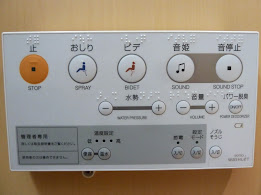
Did I mention Japan is clean? OMG! They even soap down and wax their sidewalks! One day I went into a public (think a small one stall per room at the local park where they clean it once a month and it smells from a mile away in America kind of place) toilet. This was a typical squatter although many of the buildings had super nice, heated seats, bidets, music mufflers, air your butt dry toilets. When I went in, there was not a single piece of toilet paper or trash anywhere (there never is), and as I pulled on my toilet paper roll a small piece tore off and fluttered down onto the floor. I looked around and felt terrible that the place was so clean that I reached down and carefully picked it up and put it in the toilet. I miss the pride the Japanese took in their cleanliness. Americans could take a cue...

Photo

Thursday, April 3, 2014

Seoul to Japan to Seoul - DMZ & Panmunjom

The second day my friend was in Seoul we had an all day tour booked to the DMZ and Panmunjom.

A short history for those not familiar with those names; the DMZ (demilitarized zone) and the abandoned village of Panmunjom Korea, are historical landmarks for the Korean war and the second world war. When Japan was stripped of its colonies in 1945, the 38th parallel was marked as a divider between the Soviet Union and the United States occupancy in Korea. The 38th parallel was supposed to be a temporary solution with an end goal of uniting the country under a new system of democracy, but in June of 1950 North Korea advanced on South Korea and pushed their troops nearly completely off the peninsula, save for the remaining city of B(P)usan. Realizing that a successful mission by the North Korean troops would engulf the whole of Korea into communism, the UN entered and pushed the North Koreans back to the 38th parallel. They could have stopped there, but hoping to free the entire country of communism they chose to continue pushing northward and ignored the threats from China if they continued to advance toward the Chinese border. When Korea was nearly liberated and the UN troops were closing on the border of North Korea and China, China fought back and pushed the UN troops back to the 38th parallel. This border area was mostly held during the next few years and in 1953 an armistice was signed to cease fire. There have still been bombings and aggressive actions taken by the North Koreans against the South, but a civil war has been avoided thus far.

With all that in consideration, the following is my account of the DMZ and Panmunjom tour.

We got up early, and the company I had booked the tour with, Seoul City Tours, picked us up at our hotel which was super nice and way easier than getting to the meeting place on our own. It took a while, but once everyone was collected and transferred to the tour bus we headed out to the first place called Imjingak Park. This park is very touristy, but you can see the engine from the bombed train that would run between North and South Korea. There was also a freedom bell you could ring for a fee as well as a selection of restaurants and tourist shops. I found this park unappealing and crowded and eagerly boarded the bus to the next stop, the 3rd tunnel.

Photo
Just outside the 3rd tunnel area.

The North Koreans have dug multiple tunnels and it's believed there may be more currently in process that South Korea hasn't discovered yet. But the 3rd tunnel was the shortest one between the DMZ and Seoul (the destination of the tunnel). There are no cell phones or cameras allowed in the tunnel, so I don't have any pictures to show you, but it was a neat experience. The South Koreans have a steep tunnel that descends to meet the North Korean's unfinished tunnel. From there it's a bit short for people over 5 ft and fairly narrow, but you can walk all the way through the tunnel up to the DMZ line where there is a very small window to look through toward the North Korean side. There's a bunch of barbed wire and a not so friendly looking barrier between the locked door on the South Korean side and the door on the North Korean side. After you take a quick look through the window you return back through the tunnel and ascend the steep incline back to the souvenir shop (where you can purchase North Korean alcohol btw) and also view a video in the screening room.

The tour also takes you to the train station built just on the border in South Korea that they hope one day will be the first station across the border if you're taking a train from Russia or North Korea into South Korea. Right now the station is completely vacant but is kept up in a show of faith to reunite the two countries.

Photo
This picture shows the finished ideal of a united railway system  connecting South Korea to the rest of Europe.
After this part of the tour, lunch is provided at a Korean restaurant for those that purchased it and then a few people continued on to Panmunjom.

Photo
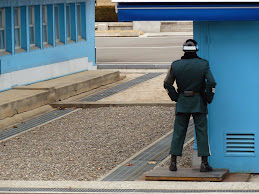
The cement slab in the middle is the border between the two countries.
That is a South Korean soldier standing in the intimidating stance they all use.

Panmunjom is located at the center of the DMZ where peace talks are held and constant security is at a high alert all the time. There is a "welcome center" on each side of the border for both the North and South Koreans. Directly on the border are a few conference rooms that literally straddle both countries. During this part of the tour, you must sign a waiver declaring you will follow all the instructions, that you will not point or make gestures toward the North Korean soldiers and are dressed according to the required attire. There is a dress code to enter Panmunjom. After the waiver is signed, you watch another video and then get on a bus to the South Korea welcome center. Everyone is instructed to walk in double lines and not to make any sudden movements or break away from the troupe. There is specific designated amounts of time to stay at each location and there is a very strict policy about which direction you may point your camera and how much zoom you can use. The Korean soldiers were all very solemn and never moved or spoke or even seemed to breath. The US soldiers there were much more relaxed and I got to joke with one and he was very pleasant and his was a refreshing smile and laugh amidst the stifling composure and solemnity that surrounded the complex.

A North Korean soldier is keep a close eye on our tour groups' activities.

After visiting the border everyone gets back on the bus to return to the souvenir shop and then all the way back to Seoul.

It was an enlightening tour and I'm extremely glad I was able to go. I would definitely recommend the experience, especially the 3rd tunnel and Panmunjom. History is always more memorable and the lessons better learned I believe, when experienced in such a fashion. My next post will be another historical one featuring my trip to Hiroshima, specifically the Peace Park.